

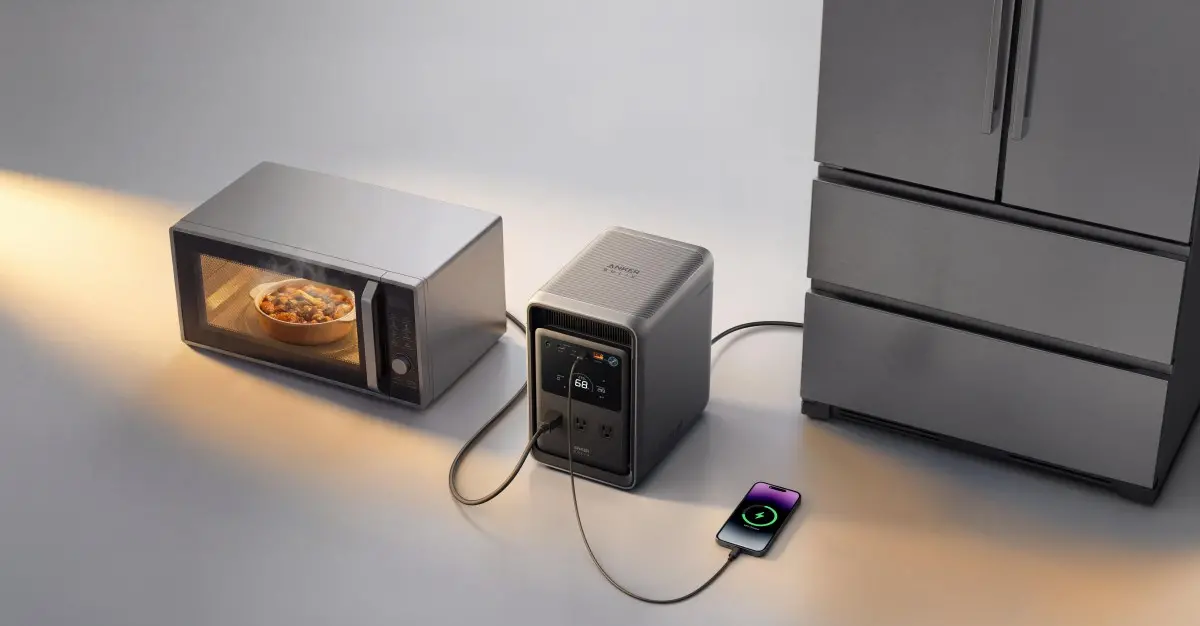
Portable power stations have become essential for outdoor enthusiasts, emergency preparedness, and off-grid living. Yet many users encounter two recurring frustrations: the battery mysteriously draining after a few days of disuse, and the sheer size of the units needed to store meaningful amounts of energy. Anker's latest entry, the Solix S2000, directly addresses both issues with a clever combination of engineering choices and aggressive pricing.
Understanding the Idle Power Problem
Most power stations in the 2kWh class rely on inverters capable of delivering 2400W or more of alternating current (AC). While this high output can run power-hungry appliances, it comes with a significant penalty: standby power consumption. Inverters and internal control systems continuously draw energy even when no device is plugged into the AC outlets. Competitors like EcoFlow's Delta 2 Max, Bluetti's AC200L, and Jackery's 2000 Plus typically consume between 20W and 40W when idle. At 30W, a 2kWh battery would be completely drained in under three days if left with the AC output on. This forces users to manually turn off the inverter after each use, an easy step to forget and one that can leave the battery dead when it's most needed.
Anker's Solix S2000 takes a different approach. Instead of fitting a high-wattage inverter, the company chose a 1500W continuous unit. This lower capacity reduces the inherent idle draw to approximately 6W, according to Anker's specifications. At that rate, the battery would last nearly two weeks before depleting – a dramatic improvement that removes the worry of phantom drain. The technology behind this efficiency is called OptiSave, which optimizes the inverter's standby circuitry and minimizes losses in the power conversion electronics.
Size Matters: Ultra-Compact Energy Storage
The second major complaint about portable power stations is their footprint. A 2kWh battery pack with a suitable inverter typically occupies a substantial amount of space, making it difficult to stow in a van, RV, or closet. The Solix S2000 measures just 208 x 282 x 323 mm (8.2 x 11.1 x 12.7 inches). This yields an energy density of about 106 watt-hours per liter (Wh/L), which comfortably beats most similarly rated competitors. For example, the EcoFlow Delta 2 Max comes in at around 78 Wh/L, while the Jackery 2000 Plus achieves approximately 82 Wh/L. The higher density means the Anker unit takes up less room in a vehicle or home while providing the same total capacity.
The compact design does not compromise on inputs and outputs. The front panel houses three AC outlets, while the rear adds two more, allowing users to keep devices plugged in without constantly moving the 35.7-pound (16.2 kg) unit. There are also two USB-C ports delivering up to 100W each, one USB-A port, and a dedicated solar charge input that supports up to 400W of photovoltaic panels. This makes it suitable for recharging during daytime off-grid use. The combination of placement-friendly dimensions and versatile ports appeals to van lifers, remote workers, and anyone who needs reliable power without sacrificing living space.
Battery Chemistry and Performance
At the heart of the Solix S2000 is a lithium iron phosphate (LFP) battery, a chemistry known for its long cycle life and thermal stability. LFP cells can typically withstand 3,000 to 5,000 charge/discharge cycles before reaching 80% capacity, far exceeding the 500–1,000 cycles of older lithium-ion chemistries. This longevity makes LFP the preferred choice for stationary backup and daily use in mobile applications. The 2kWh capacity is sufficient to run a large refrigerator/freezer combo for over 24 hours during a power outage, or to keep a CPAP machine, lights, and communication devices operational through the night.
Although the inverter is rated at 1500W continuous, the unit can handle short bursts up to 3000W, enough to start a hair dryer or a small air conditioner. For most household appliances – coffee makers, induction cooktops, water boilers, laptops, and networking gear – 1500W is ample. Anker's engineers have prioritized efficiency over raw peak power, arguing that the vast majority of users rarely need more than 1500W for sustained periods. The trade-off is acceptable for the significant reduction in idle draw and size.
Market Positioning and Pricing Strategy
Anker is launching the Solix S2000 with an aggressive introductory discount. Customers who preorder before June 1st can secure the unit for $599. After that date, the price will settle between $679.99 and $1,199.99, depending on coupons and promotions – a common tactic in the power station market. At the $599 level, the cost per watt-hour is approximately $0.29, which undercuts many competitors. For comparison, the EcoFlow Delta 2 Max (2kWh) often retails for around $1,099, and the Jackery 2000 Plus starts at $1,299. Even at the higher end of Anker's projected range, the Solix S2000 offers strong value given its compact dimensions and low idle power.
The company has not yet announced EU pricing or shipping dates, but expects to provide details in the coming weeks. Global demand for medium-capacity portable power stations has grown steadily as more people work remotely from vans, campers, and boats, and as homeowners seek affordable backup solutions for increasingly frequent extreme weather events. Anker's reputation for reliable consumer electronics, coupled with the Solix S2000's targeted improvements, positions it to capture a significant share of this market.
Detailed Technical Analysis
To appreciate the engineering behind the S2000, it helps to understand how idle power drain occurs in typical power stations. The inverter is the largest culprit: it must keep its internal oscillator and switching transistors biased and ready to produce AC power on demand. Even when no load is connected, these circuits consume several watts. Additionally, the battery management system (BMS), display, Wi‑Fi or Bluetooth module, and fan controller all draw small amounts of power. In many designs, the sum of these parasitic loads reaches 30W or more. Anker reduced this by using a lower‑rated inverter (1500W instead of 2400W), which inherently requires less bias current, and by optimizing the control electronics to cut power to non-essential subsystems when the AC output is enabled but unused.
The compact dimensions are achieved through a combination of high‑density LFP cells and a tightly integrated layout. LFP cells have a lower energy density by weight compared to NMC (nickel manganese cobalt) cells, but they are safer and last longer. Anker manages to keep the overall volume down by using prismatic cells with minimal packaging overhead and by placing the inverter, charge controller, and BMS in a single, well-ventilated enclosure. The result is a unit that is easier to stow under a bed, behind a seat, or in a closet than most of its peers.
Comparison with Rivals
The EcoFlow Delta 2 Max, one of the most popular 2kWh power stations, offers a 2400W inverter and a larger 2kWh LFP battery. It also features expandable capacity with extra batteries, but its idle draw of around 30W means users must actively manage the inverter state. Its dimensions are 400 x 225 x 280 mm, giving an energy density of about 78 Wh/L. Bluetti's AC200L outputs 2400W and includes a 2kWh LFP battery, with an idle consumption of roughly 25W. Its size is 420 x 280 x 390 mm (about 70 Wh/L). The Jackery 2000 Plus uses NMC cells (though newer models are transitioning to LFP) and offers 2400W output, but its idle draw is also over 20W. Its volume is larger relative to capacity, around 82 Wh/L. The Anker Solix S2000 beats all of these in standby efficiency and space utilization, though it cannot match the peak output of its competitors. For many users, the trade-off is worthwhile.
Another important consideration is noise. The S2000 includes a variable-speed fan that operates only when needed; at idle or low loads, the unit is silent. Competitors often run their cooling fans continuously, contributing to audible background noise in quiet environments like a van or bedroom.
Early hands-on reviews have praised the build quality, the intuitive control panel, and the responsiveness of the app (though app connectivity is optional). The unit supports pass-through charging, meaning it can power devices while simultaneously charging from solar or AC mains. This feature is standard in many power stations but is still welcome.
The Solix S2000 is available for preorder directly from Anker's website. Given the limited-time discount, early adopters are likely to secure the best price. The unit ships with a standard AC charging brick, a car charging cable, and a solar adapter cable. The included documentation covers safety guidelines, typical run times, and troubleshooting tips.
Anker has also announced that the S2000 will be compatible with its future expansion battery packs, allowing users to double the capacity to 4kWh should their needs grow. The expansion batteries are expected to launch later this year, further enhancing the flexibility of the system. For now, the standalone unit provides a solid foundation for anyone seeking reliable, portable power without the usual frustrations of phantom drain and oversized hardware.
Source: The Verge News