

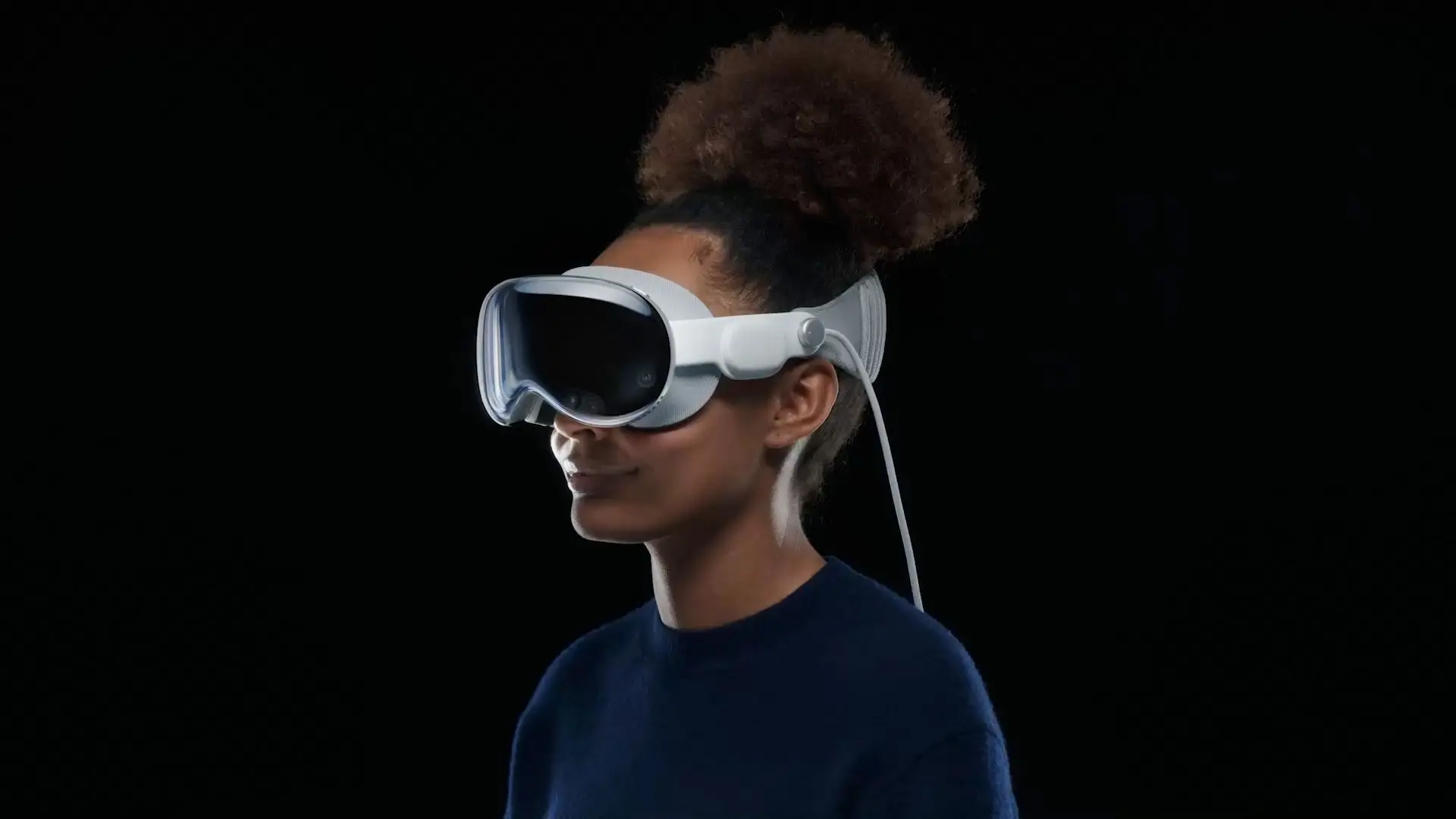
Apple Vision Pro is Apple's most advanced mixed reality headset, launched in February 2024 and updated with the M5 chip in October 2025. Priced at $3,500, it remains a high-end spatial computer that blends augmented and virtual reality experiences. The device is designed to be worn over the head like ski goggles, featuring a laminated glass front and aluminum alloy frame. It uses an array of cameras and sensors to map the environment and track eye movements, hand gestures, and voice commands for navigation, eliminating the need for physical controllers.
Design and Display Upgrades
The M5 Vision Pro introduces a new Dual Knit Band, replacing the original Solo Knit Band. This band has two straps—one that goes around the back of the head and another that goes over the top—distributing the headset's weight more evenly. Apple claims the band is breathable, cushiony, and stretchy, with flexible fabric ribs and tungsten inserts acting as counterweights. Reviews have confirmed that the Dual Knit Band significantly improves comfort during extended use, reducing pressure on the face and neck strain. However, at over 1.3 pounds, the Vision Pro remains heavy, and fatigue can still set in after a few hours.
The headset's micro-OLED displays deliver over 4K resolution per eye, totaling 23 million pixels. With the M5 chip, the Vision Pro can now render 10 percent more pixels for crisper text and more detailed visuals, and supports a 120Hz refresh rate for smoother motion and reduced blur when viewing surroundings or connecting to a Mac. The external EyeSight display projects the wearer's eyes to others, indicating whether they are in an immersive or see-through mode.
Performance and Processing
The M5 chip, built on third-generation 3-nanometer technology, features a 10-core CPU and 10-core GPU with enhanced AI capabilities. It is paired with the R1 chip, which processes input from cameras, sensors, and microphones with virtually no latency. Apple boosted unified memory bandwidth to 153GB/s, and the device includes 16GB of RAM. Performance improvements are evident: apps and widgets load faster, spatial persona generation is quicker, and AI-powered features like spatial scenes and Personas are more efficient. Reviewers noted more consistent performance with no lag or stuttering, though the difference over the M2 model is not dramatic.
The Vision Pro supports Wi-Fi 6 but not the faster Wi-Fi 6E. Storage options include 256GB, 512GB, and 1TB. Battery life has improved slightly: up to 3 hours for video playback and 2.5 hours for general use, compared to 2 hours for the M2 version. The external battery pack can be swapped for extended use, and the headset can also be plugged into a power adapter for all-day operation.
Software and Ecosystem
visionOS is the operating system that runs the Vision Pro, offering a three-dimensional interface navigated by eye movements, hand gestures, and voice. Users can place apps anywhere in virtual space, resize windows, and adjust immersion using the Digital Crown. The device runs iPhone and iPad apps in addition to dedicated visionOS apps from the App Store. Mac integration allows the Vision Pro to serve as a virtual display, with Wide and Ultrawide modes in visionOS 2.2 providing screen space equivalent to two 4K displays.
FaceTime has been redesigned for Vision Pro, using a digital Persona that reflects the wearer's facial expressions and hand movements in real time. Spatial Audio is delivered through speakers built into the head straps, and users can connect AirPods Pro 2 or 3 for lossless, low-latency audio. The headset also supports Bluetooth keyboards, mice, trackpads, and game controllers.
Buying Advice and Limitations
Given the $3,500 price tag, the Vision Pro remains a niche product. Reviewers agree that it is best suited for watching movies, viewing 3D content, and using as a Mac display. The limited app ecosystem and lack of game controllers out of the box are drawbacks. Apple recommends trying the headset in an Apple Store before purchasing. The M5 upgrade makes now a good time to buy, as a next-generation headset is not expected for at least two years, and development on a cheaper version is paused.
Medical warnings apply: the Vision Pro may exacerbate conditions such as migraines, seizures, balance disorders, and eye strain. Pregnant individuals should use caution due to increased risk of nausea. The device and its battery pack can interfere with pacemakers and other medical implants.
Future Plans: Smart Glasses and Cheaper Headset
Apple is reportedly developing smart glasses similar to Meta Ray-Bans, with speakers, microphones, and a camera for AI features but no display. These are expected to launch in late 2026 or 2027. A second-generation Vision Pro or a cheaper enclosed headset is not in active development, though Apple continues to research new materials for future lightweight devices. Augmented reality glasses that connect to a Mac were halted in January 2025, but Tim Cook remains committed to AR glasses in the long term. Apple has also tested using the Vision Pro for mental health detection and heart health monitoring through eye-tracking cameras.
The Vision Pro with M5 chip is available directly from Apple in multiple countries, including the US, UK, Canada, China, and Japan. Zeiss prescription lens inserts cost $149, while reading lenses are $99. No trade-in program exists for the older M2 model.
Source: MacRumors News