

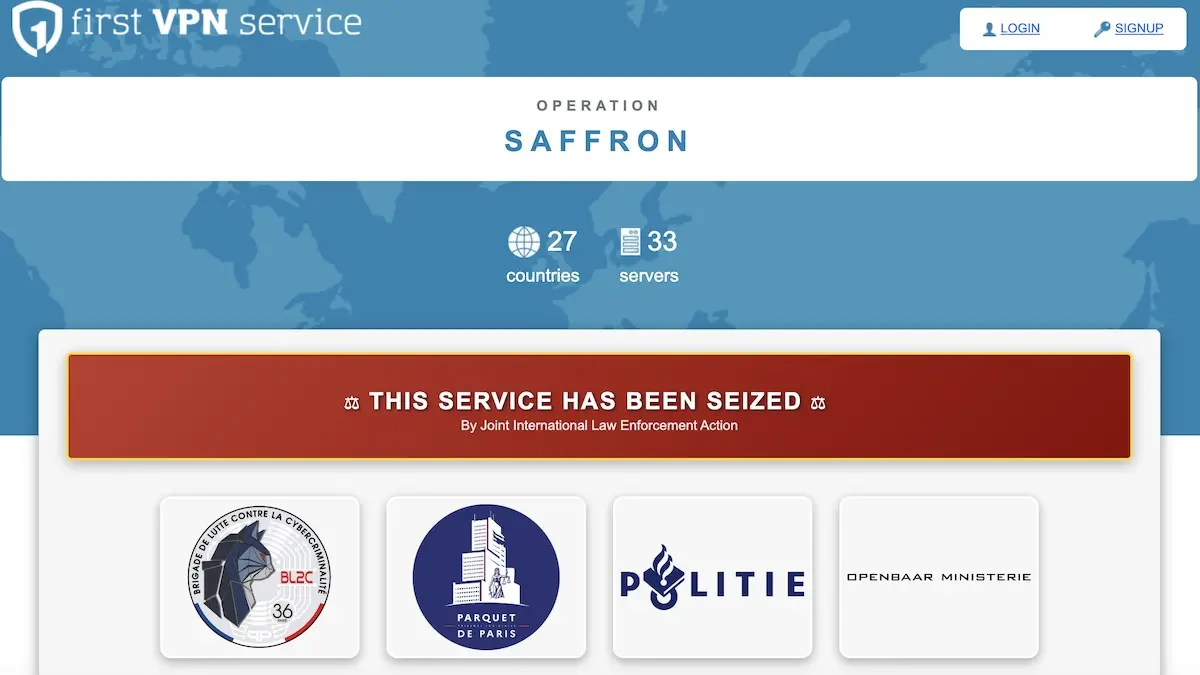
In a coordinated international operation, law enforcement agencies from North America and Europe have successfully disrupted First VPN, a long-standing cybercrime service that provided anonymized network access to ransomware groups and other malicious actors. The operation, which involved the FBI, Europol, and multiple partner agencies, resulted in the arrest of the service's alleged administrator in Ukraine and the dismantling of 33 servers across multiple jurisdictions.
Background on First VPN
First VPN had been operational since 2014, offering a VPN service specifically marketed to cybercriminals on Russian-language dark web forums. At the time of its disruption, the service operated 32 exit nodes spread across 27 countries, allowing users to mask their true IP addresses and evade detection during network reconnaissance, exploitation, and data exfiltration. According to the FBI, at least 25 distinct ransomware groups relied on First VPN to facilitate their attacks, including well-known strains that have caused billions of dollars in damages worldwide.
The service was advertised as a turnkey solution for anonymity, promising users that their activities would remain beyond the reach of law enforcement. However, investigators were able to trace the infrastructure back to its administrator, demonstrating that no cybercrime service is truly immune to detection. The takedown targeted multiple domains, including 1vpns.com, 1vpns.net, 1vpns.org, and associated onion addresses on the Tor network.
Operation Details
The law enforcement action was led by the FBI's Cyber Division in coordination with Europol's European Cybercrime Centre (EC3). Technical assistance was provided by cybersecurity firm Bitdefender, which helped analyze the service's infrastructure and identify its user base. In total, 33 servers were seized or taken offline, effectively neutralizing First VPN's ability to support criminal operations.
Europol confirmed that users of the service have been notified of the shutdown and informed that they have been identified. Information on 506 users was shared internationally with partner agencies for further investigation. Bitdefender noted that these 506 users represent a subset of First VPN's customer base, and investigators are now working to determine which of them can be linked to specific criminal operations, such as ransomware attacks, data theft campaigns, or botnet management.
Impact on Ransomware and Cybercrime
First VPN had been used extensively for network reconnaissance, scanning for vulnerabilities, launching distributed denial-of-service (DDoS) attacks, and exfiltrating stolen data. Over the years, its IP addresses were associated with numerous high-profile ransomware incidents, including those targeting healthcare, education, and critical infrastructure. By providing a layer of anonymity, the service lowered the barrier for entry into cybercrime, allowing less technically skilled actors to participate in sophisticated attacks.
The FBI has published a technical alert containing indicators of compromise (IoCs), MITRE ATT&CK mappings, and recommendations for organizations to detect and mitigate threats associated with First VPN. These resources are intended to help network defenders identify past intrusions and strengthen their security posture against future attacks.
Bitdefender's involvement highlights the growing role of private-sector cybersecurity firms in supporting law enforcement operations. In a statement, the company emphasized that while this takedown is a significant victory, the underlying demand for anonymization services remains high. "New anonymization services will appear. The economic demand hasn’t changed. But each takedown shortens the operational window of the next service and raises the barrier for actors who relied on turnkey solutions," a Bitdefender spokesperson said. "First VPN advertised itself as a service criminals could trust to keep them beyond law enforcement’s reach. The operation proved that claim wrong, and every actor evaluating the next anonymization service now knows the same risk exists."
Broader Context of Cybercrime Service Disruptions
This operation is part of a larger trend of law enforcement targeting the infrastructure that enables cybercrime. In recent months, Microsoft and international partners disrupted the RedVDS cybercrime service, which provided virtual private servers for hosting malware and command-and-control infrastructure. Similarly, the Aisuru and Kimwolf DDoS botnets were taken down in a separate international operation. These actions collectively signal a shift toward disrupting the supply chain of cybercrime, rather than solely pursuing individual actors.
The arrest of the First VPN administrator in Ukraine is particularly notable because Ukraine has become a key battleground in the fight against cybercrime, with its cyber police cooperating closely with international agencies. The administrator now faces charges that could lead to extradition to the United States or other countries where victims are located.
Technical Analysis and Recommendations
From a technical perspective, First VPN was designed to provide a high degree of anonymity, but investigators were able to overcome this through forensic analysis of server logs, financial transactions, and communications on underground forums. The FBI's alert includes a list of IP addresses and domains associated with First VPN, as well as recommended detection rules based on network traffic patterns and endpoint indicators.
Organizations are advised to review their logs for connections to the identified IP addresses and to implement network segmentation and access controls to limit the impact of potential breaches. The MITRE ATT&CK framework mappings provided in the alert can help security teams identify the specific techniques used by First VPN customers, such as T1046 (Network Service Scanning) and T1071 (Application Layer Protocol).
Bitdefender also recommends that enterprises adopt a zero-trust architecture and deploy endpoint detection and response (EDR) solutions capable of identifying anomalous outbound connections. For smaller organizations without dedicated security teams, managed detection and response (MDR) services can provide similar protections.
Future Implications for Cybercrime Ecosystem
The takedown of First VPN sends a clear message to the cybercriminal underground that law enforcement is increasingly capable of penetrating even the most carefully guarded services. However, as Bitdefender noted, the economic incentives for cybercrime remain strong, and new services will inevitably emerge to fill the void. The key to long-term success lies in sustained pressure on infrastructure providers, combined with efforts to disrupt the financial flows that sustain these operations.
The identification of 506 users provides an unprecedented opportunity for prosecutors to pursue individual actors, potentially leading to further arrests and dismantling of ransomware groups. Europol has stated that the investigation is ongoing and that additional actions may be announced in the coming months.
For defenders, the lesson is clear: no service, no matter how well-advertised or trusted, can guarantee complete anonymity. Each takedown erodes the trust that criminals place in these platforms, making it harder for them to operate efficiently. As the cybercrime ecosystem becomes more fragmented, organizations must remain vigilant and continue to share threat intelligence with law enforcement and industry partners.
Source: SecurityWeek News