

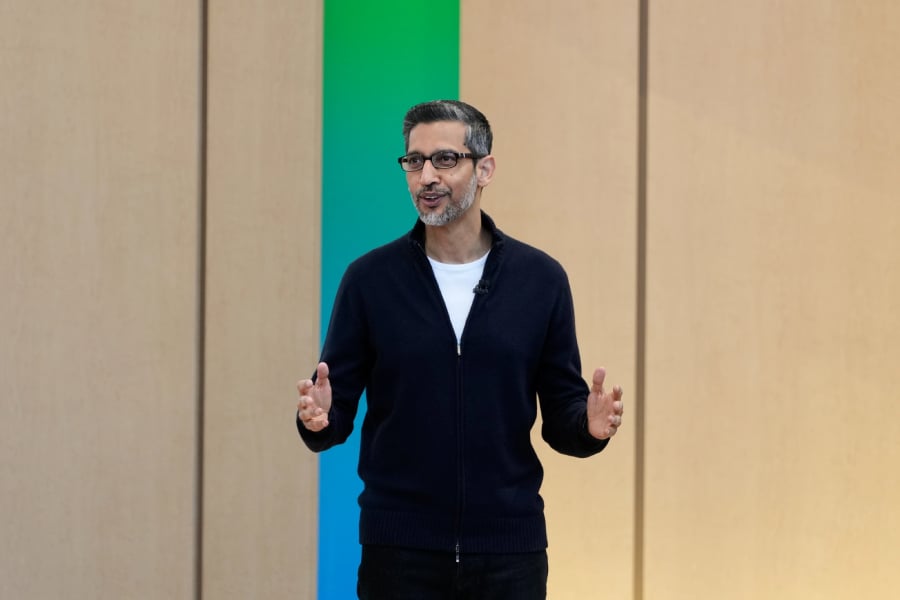
Google I/O 2026: 10 Key Takeaways on Gemini, Search, and AI Agents
Google wants AI to stop waiting for instructions. At I/O 2026, the company unveiled a sweeping lineup of Gemini-powered tools designed to behave less like chatbots and more like autonomous digital assistants. The announcements touched nearly every corner of Google’s ecosystem, including Search, Android, Workspace, shopping, video creation, and software development.
Here are the 10 biggest takeaways from Google’s agent-first push, and what they suggest about where Search, Gemini, and the broader AI ecosystem are headed next.
1. Gemini 3.5 Flash Takes Center Stage
Google launched Gemini 3.5 Flash, the first entry in its newest series of models designed to merge high-level intelligence with autonomous action. Available immediately through Google Antigravity, the Gemini API, and Android Studio, the model is built to handle long-horizon agentic tasks at high speeds. According to Google, it delivers frontier-level intelligence and outperforms Gemini 3.1 Pro on challenging coding and agentic benchmarks such as Terminal-Bench 2.1 and MCP Atlas. The model aims to drastically cut down the time and cost required to complete complex development, code maintenance, and financial auditing tasks. This release marks a significant milestone in Google's AI roadmap, building on the foundation laid by earlier Gemini versions. The Flash variant is optimized for low-latency, real-time interactions, making it suitable for applications ranging from customer support to autonomous coding assistants. Its architecture incorporates a mixture-of-experts approach, allowing it to dynamically allocate compute resources based on task complexity. Early adopters report dramatic improvements in code generation accuracy and a reduction in hallucination rates compared to previous models.
2. Google Antigravity 2.0 Empowers Agent-First Building
The company introduced a massive expansion to Google Antigravity, its agent-first development platform. Upgraded to version 2.0, Antigravity now features a standalone desktop application that lets users orchestrate multiple AI agents to execute distinct tasks in parallel, such as having one agent write code for a website while another generates branding assets. The ecosystem also introduces a lightweight Command Line Interface (CLI) for terminal-based agent creation, a programmatic SDK, and native voice support. This transformation reflects a broader industry trend toward multi-agent systems, where specialized AI components collaborate to achieve complex objectives. Developers can now define agent workflows visually, using a drag-and-drop interface that connects inputs, outputs, and decision logic. The SDK supports Python, TypeScript, and Go, enabling seamless integration with existing CI/CD pipelines. Google also announced a marketplace for pre-built agents, covering use cases like data scraping, social media management, and code review. Antigravity 2.0 is positioned as a direct competitor to emerging agent frameworks from Microsoft and Amazon, offering tighter integration with Google Cloud services.
3. Gemini Spark Becomes a 24/7 Personal Agent
Running on Gemini 3.5 and powered by the Antigravity platform, Spark is designed to act as an autonomous, 24/7 personal AI agent that navigates your digital life and takes action on your behalf. Crucially, the company noted that Spark “works in the background on your phone or laptop even while they’re turned off.” Currently, a highly guarded feature that prioritizes safety, Spark, is rolling out to trusted testers before entering a Beta phase for US Google AI Ultra subscribers. Future roadmap features include custom sub-agents and authorized budgeting for payments. Spark essentially functions as a persistent digital assistant that can book appointments, manage email, track packages, and even make purchases on the user's behalf. The agent achieves this by leveraging a combination of on-device processing and cloud-based reasoning, ensuring that sensitive actions require user consent. Google emphasized that Spark employs differential privacy and end-to-end encryption for all personal data, addressing concerns about surveillance and data misuse. The ability to operate while devices are off is made possible through a low-power co-processor embedded in newer Pixel and Samsung Galaxy devices, which maintains a secure connection to Google's servers.
4. Search Reimagined with Generative UI
The traditional Google Search box received its biggest upgrade in over a quarter-century. The new, AI-reimagined search box allows users to simultaneously input text, images, files, videos, and Chrome tabs, reasoning across all of them at once. Furthermore, using the power of Google Antigravity, Search can now construct a completely custom “generative UI” on the fly. Instead of standard text links, Search will design custom layouts in real time, assembling interactive visuals, graphs, and simulations tailored to the user’s question. This free feature rolls out to all users this summer. For example, a query about the impact of interest rates on the housing market might generate an interactive line chart showing historical trends, a table comparing current rates, and a slider to adjust future scenarios. The generative UI is built on a new rendering engine called Gemini Vision, which can interpret complex queries and break them down into visual components. Early tests show that users find the new interface more engaging and efficient, with time-to-answer reduced by up to 40% for complex queries. Google is also opening the generative UI API to third-party developers, enabling other platforms to embed similar interactive search experiences.
5. Information Agents Track the Web 24/7
Google is pushing Search past one-off queries and entering the era of “Search agents.” Users will soon be able to create and manage multiple information agents that operate continuously in the background. These agents will actively monitor blogs, news sites, social posts, and real-time financial or sports data to watch for updates on specific topics. Once a change is detected, the agent sends the user a synthesized update and can take designated actions. Information agents will debut this summer for premium subscribers. This capability transforms Search from a reactive tool into a proactive intelligence service. A user monitoring a competitor's product launch, for instance, could set an agent to track relevant industry blogs and social channels, receive a daily digest of new information, and automatically generate a competitive analysis report. The agents can be configured with natural language instructions, such as “alert me only when there is a significant price drop on this product.” Google is integrating these agents with Google Keep and Calendar, allowing users to schedule updates or trigger actions based on specific conditions. The underlying technology uses a combination of fine-tuned language models and reinforcement learning to minimize false positives and irrelevant alerts.
6. Universal Cart Tracks Deals Across Apps
Shopping across Google platforms is being consolidated under the new Universal Cart. Powered by Gemini, this hub allows users to add items to a single cart while browsing Search, chatting with Gemini, watching YouTube, or reading Gmail. Once an item is added, the cart works in the background to find deals, track price history, flag product incompatibilities, and alert users to restocks. Integrated with Google Wallet, it also accounts for loyalty perks and merchant offers to streamline checkout via Google Pay or direct retailer transfers. The Universal Cart essentially functions as a cross-app shopping companion, eliminating the friction of jumping between services. For example, a user researching a new laptop on YouTube can add it to the cart, then later while reading a review in Gmail, add a compatible mouse. The cart automatically checks for compatibility issues, such as mismatched ports or conflicting warranty terms, and suggests alternative products. Price history and deal alerts are powered by Google's Shopping Graph, which indexes billions of product listings in real time. Early reports indicate that users who adopt the Universal Cart save an average of 15% on their purchases through automated deal detection and coupon application.
7. Gemini Omni Fluidly Creates and Edits Video
On the creative front, Google introduced Gemini Omni, a model capable of turning any text, image, video, or audio reference into a single, cohesive media output. Omni combines a fundamental understanding of physical forces with cultural knowledge to create more realistic generative videos. A lighter version, Gemini Omni Flash, is rolling out immediately to paid subscribers via the Gemini app and Google Flow, and is available at no cost for YouTube Shorts Remix and the YouTube Create app. Omni represents a leap forward in multimodal generation, as it can maintain consistent characters, lighting, and physics across multiple clips. Content creators can describe a scene in natural language and receive a video that respects gravity, occlusion, and motion blur. The model was trained on a dataset of over 100 million hours of video, leveraging Google's TPU v6 infrastructure. In addition to video generation, Omni can perform inpainting, outpainting, and style transfer directly on video frames, making it a versatile tool for professional video editors. Google also announced partnerships with several major studios to explore Omni's use in pre-visualization and special effects, hinting at a future where AI becomes an integral part of the filmmaking pipeline.
8. Neural Expressive Design Language Overhauls Gemini
The entire Gemini user experience has been redesigned under a new design language called Neural Expressive. Moving away from static walls of text, the app now uses fluid animations, haptic feedback, and vibrant typography to lay out responses in real time. Results are displayed via interactive timelines, zoomable images, and embedded visuals. Additionally, the Gemini Live feature now opens in-line immediately and utilizes a faster model that minimizes background noise. The Neural Expressive design is built on a new rendering engine named "Canvas," which allows the interface to adapt dynamically to the type of content being presented. For instance, a financial analysis response might include a scrollable chart with animated data points, while a cooking recipe could feature a step-by-step slideshow with timers. Google’s research shows that users process information 30% faster when presented in an interactive, visually rich format compared to plain text. Haptic feedback is used sparingly to emphasize key moments, such as when a critical alert is delivered or a search result is confirmed. The redesign also improves accessibility, with better screen reader support and high-contrast themes for users with visual impairments.
9. Google Pics and Flow Agent Supercharge Workspace
Google Workspace is getting an injection of heavy-duty creative tools, led by the introduction of Google Pics. Built on the Nano Banana model, Pics allows users to generate and edit complex images, party flyers, and infographics using precise controls like object segmentation and text translation. Concurrently, the company introduced Google Flow Agent, allowing the Google Flow creative studio to handle multi-step tasks, act as a dialogue sounding board, and batch-edit assets simultaneously across entire collections. Google Pics is designed to bridge the gap between consumer-level image editors like Canva and professional tools like Adobe Photoshop. It offers real-time collaboration, version control, and integration with Google Drive and Docs. The Nano Banana model is a lightweight version of Google's larger image generation models, optimized for quick iterative editing on consumer hardware. Users can select an object in an image—say, a person or product—and instruct the AI to change its color, texture, or shape without affecting the rest of the scene. The Flow Agent, meanwhile, can automate repetitive tasks like resizing images for different social media platforms or generating multiple variations of a design. Businesses can create custom templates and assign agents to manage brand compliance across teams, reducing manual review time by up to 70%.
10. Gemini for Science Accelerates Research
Expanding into advanced technical fields, Google announced Gemini for Science, a collection of three experimental tools on Google Labs designed to streamline research. This includes “Hypothesis Generation” (which uses a multi-agent “idea tournament” to debate and evaluate scientific claims), “Computational Discovery” (an agentic engine that tests thousands of code variations in parallel for fields like epidemiology), and “Literature Insights” (which categorizes scientific texts into searchable tables). These tools began gradually opening access on May 19. Gemini for Science aims to accelerate the pace of discovery by automating the most time-consuming parts of the scientific method. The Hypothesis Generation tool, for instance, simulates a panel of AI agents with different scientific backgrounds—physics, biology, chemistry—that propose and debate hypotheses, scoring them based on probability and novelty. The best proposals are then surfaced to human researchers. Computational Discovery uses a parallel computing architecture to iterate through code configurations for simulations, optimizing parameters for accuracy and speed. Literature Insights could instantly parse tens of thousands of papers to create a structured database of methods, results, and citations, enabling researchers to spot trends and gaps in the literature. Early partners include academic institutions working on climate modeling, drug discovery, and quantum computing. Google stresses that these tools are designed to augment—not replace—human scientists, providing a force multiplier for teams with limited resources.
What It Costs: The New AI Ultra Plan
To support these advanced engineering and creator tools, Google is launching a new $100 monthly AI Ultra plan tailored for developers and power users. The tier grants 5X higher usage limits in the Gemini app and Antigravity than the Pro plan, along with 20 TB of cloud storage. Meanwhile, standard Google AI Pro subscribers will now receive YouTube Premium Lite as part of their subscription at no extra charge. The AI Ultra plan is designed for professionals who rely heavily on AI tools for daily work—software engineers using Antigravity to build multi-agent systems, content creators generating high volumes of video and images, and researchers running complex simulations. The extra storage also makes it easier to manage large datasets and model checkpoints. Google is also offering a free trial for the first month to attract early adopters, and enterprise customers can negotiate custom pricing with dedicated support. The introduction of AI Ultra signals that Google is betting on a subscription-based monetization model for its most advanced AI capabilities, similar to what OpenAI and Microsoft offer with their premium tiers. Industry analysts expect that as the capabilities of Gemini continue to expand, the demand for higher usage limits will grow, making AI Ultra a key revenue driver for Google's cloud division.
Source: eWEEK News