

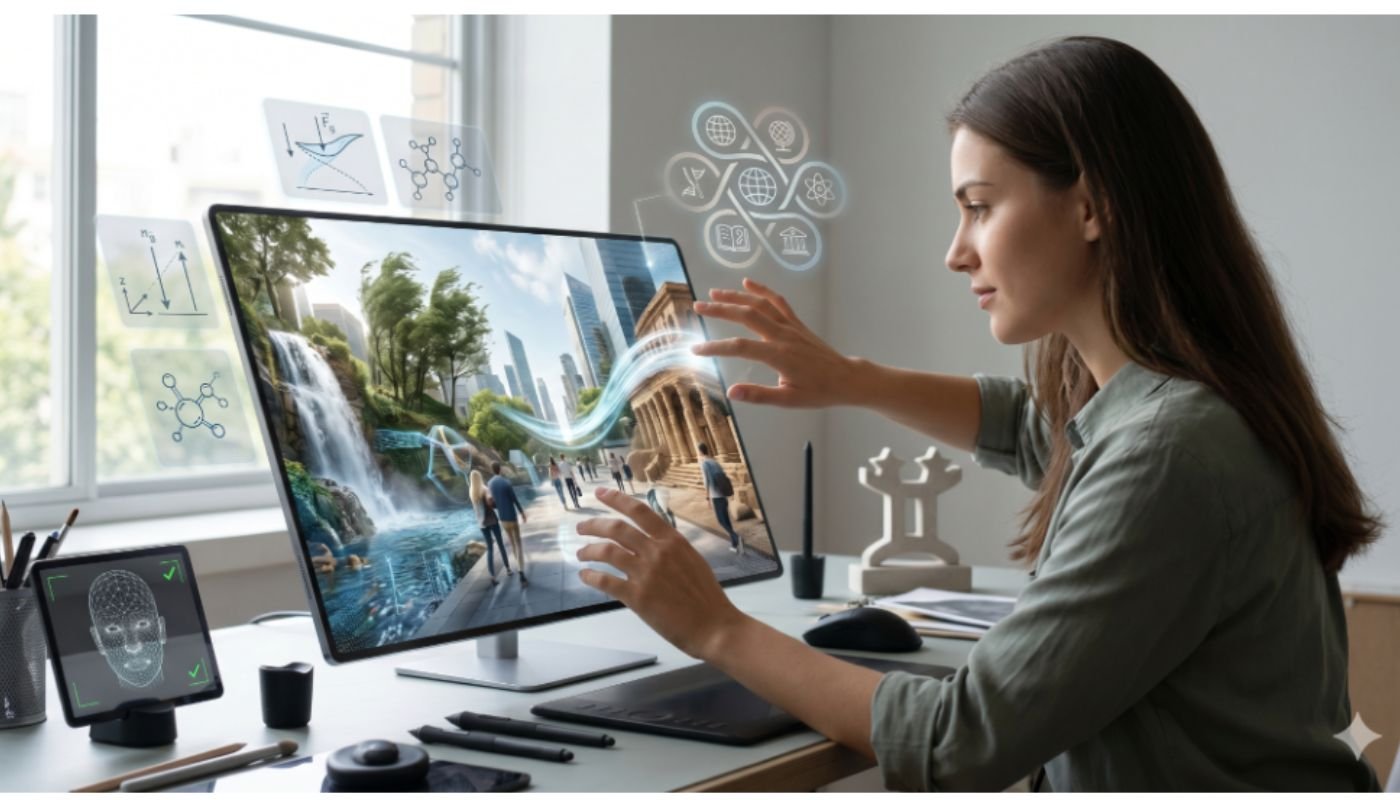
Google DeepMind has announced Gemini Omni, a new artificial intelligence model that can take a video prompt and generate a wide range of content including images, audio, and full video snippets. The model, part of the Gemini family, is designed to understand not just text or images but also the temporal and spatial dynamics of video, allowing it to produce coherent outputs across multiple modalities.
What Is Gemini Omni?
Gemini Omni is a multimodal AI system that processes video inputs—such as a short clip of a person walking or a scene from nature—and then creates new content based on that prompt. Unlike earlier models that required separate tools for each type of output, Omni integrates generation capabilities for text, images, video, and audio into a single pipeline. This unification is a significant step toward general-purpose AI that can assist creators, designers, and marketers with complex workflows.
The underlying architecture extends the Gemini family's previous work on multimodal understanding. Gemini, first introduced in 2023, could analyze text, images, audio, and video. With Omni, the emphasis shifts from understanding to generation: the model can now produce new images, sounds, and video clips that match the style, content, or motion of the input prompt.
Key Capabilities
- Video-to-Video Generation: Given a short video prompt, Omni can generate a longer video clip that continues the action or creates a new scene with similar visual characteristics.
- Image Generation from Video: It can extract key frames and produce high-resolution images that capture moments from the video, with options to adjust style or composition.
- Audio Synthesis: The model can generate ambient sounds, voiceovers, or music that fits the mood of the video, using both the visual and motion cues.
- Text Descriptions and Captions: Omni can produce narrations, captions, or even scripts that describe the video content, useful for accessibility and content metadata.
Training Data and Scale
Gemini Omni was trained on a massive dataset comprising public video clips, audio recordings, image collections, and text corpora. Google DeepMind has not disclosed the exact size, but estimates suggest it involves billions of video frames and corresponding text annotations. The training employed self-supervised learning on video-audio-text triplets, enabling the model to learn cross-modal relationships. As with other Gemini models, Omni was trained using thousands of TPU accelerators across Google's data centers.
One challenge in training such a model is ensuring consistency across modalities. If the model generates a video of a person jumping, the corresponding audio should have a realistic thud or landing sound. Omni uses a unified transformer architecture that processes all modalities jointly, rather than generating them separately. This joint training reduces discrepancies and improves output quality.
Applications and Use Cases
Creators, filmmakers, and social media influencers are expected to benefit from Gemini Omni. For instance, a filmmaker could upload a short clip of a forest scene and ask the model to generate a longer sequence with different lighting or to add bird sounds. Digital artists could use the video prompt to generate still images that match the aesthetic of a specific shot.
Marketing professionals could create promotional videos from a single initial clip, automatically generating multiple variants for different platforms. E-commerce applications might include generating product demonstration videos from short recorded demos. Additionally, accessibility tools could use Omni to generate descriptive audio for visually impaired users based on a video input.
In education, teachers could provide a short video of a science experiment and have the model generate step-by-step instructions, images, and a narrated explanation. Journalists could use it to produce summaries or visualizations from raw video footage.
Comparison to Previous Models
Google's earlier models, such as Imagen for image generation and AudioLM for audio generation, were limited to single modalities. Meta's Make-A-Video and OpenAI's Sora already demonstrated video generation, but Sora primarily generates video from text prompts and does not handle audio generation as a combined output. Gemini Omni distinguishes itself by accepting video as input and outputting multiple modalities simultaneously. This input-output cycle aligns with the vision of a “omnipotent” assistant that can create anything from a single source.
Another key difference is efficiency. Omni's unified architecture reduces the need for multiple pipelines and allows for faster generation times. However, the model still requires significant computational resources, and Google has not yet announced a public API or pricing model.
Limitations and Ethical Considerations
Despite its impressive capabilities, Gemini Omni has several limitations. The quality of generated video can vary, especially for complex scenes with multiple interacting objects. The model sometimes produces artifacts or inconsistent motion. Audio generation may lack fine detail, such as subtle background sounds. Google is aware of these issues and plans to release iterative improvements.
Ethical concerns around deepfakes and misinformation are paramount. Since Omni can generate realistic video from a single prompt, it could be misused to fabricate content. Google DeepMind has implemented safety measures including watermarking, content filters, and restrictions on generating images of public figures without consent. The model is currently in an internal research stage and not widely available. Google is also collaborating with social media companies to detect synthetic content.
Bias is another issue. Training data from the internet may contain underrepresented groups or stereotypes, potentially leading to biased outputs. Google is investing in diverse datasets and fairness evaluations, but complete elimination of bias remains challenging.
Technical Architecture Details
While specific architecture details are not fully public, early technical reports indicate that Gemini Omni uses a transformer encoder-decoder with separate modality-specific encoders for video frames, audio waveforms, and text. These encoders produce embeddings that are concatenated and processed by a shared transformer. The decoder then generates outputs for each modality using separate heads: a video decoder (likely a diffusion or autoregressive model), an audio synthesizer, and a text language model. The model uses causal masking to respect temporal order in video and audio.
To handle the high dimensionality of video, Omni employs a spatio-temporal compression that reduces the number of tokens. This is similar to the tokenization used in VideoPoet or Phenaki. For audio, it uses a mel-spectrogram tokenizer.
Future Directions
Google sees Gemini Omni as a stepping stone toward artificial general intelligence (AGI). The company believes that the ability to understand and generate any medium from a single input is fundamental to human-like creativity. Future versions may incorporate real-time generation, higher resolution, and interactive editing where users can modify generated content through natural language commands.
Integration with Google's suite of products—such as YouTube, Google Photos, and Workspace—is likely, enabling users to generate content directly within those platforms. For example, a user could take a video from Google Photos and ask Gemini to create a short movie with background music and narration.
Competitors are not idle. OpenAI's Sora continues to improve, and Meta is working on similar multimodal generation systems. Microsoft has invested heavily in generative AI and could leverage its partnership with OpenAI to compete. The race to create the most versatile content generation model is heating up, and Gemini Omni positions Google as a leader in video-to-multimodal generation.
Source: eWEEK News