

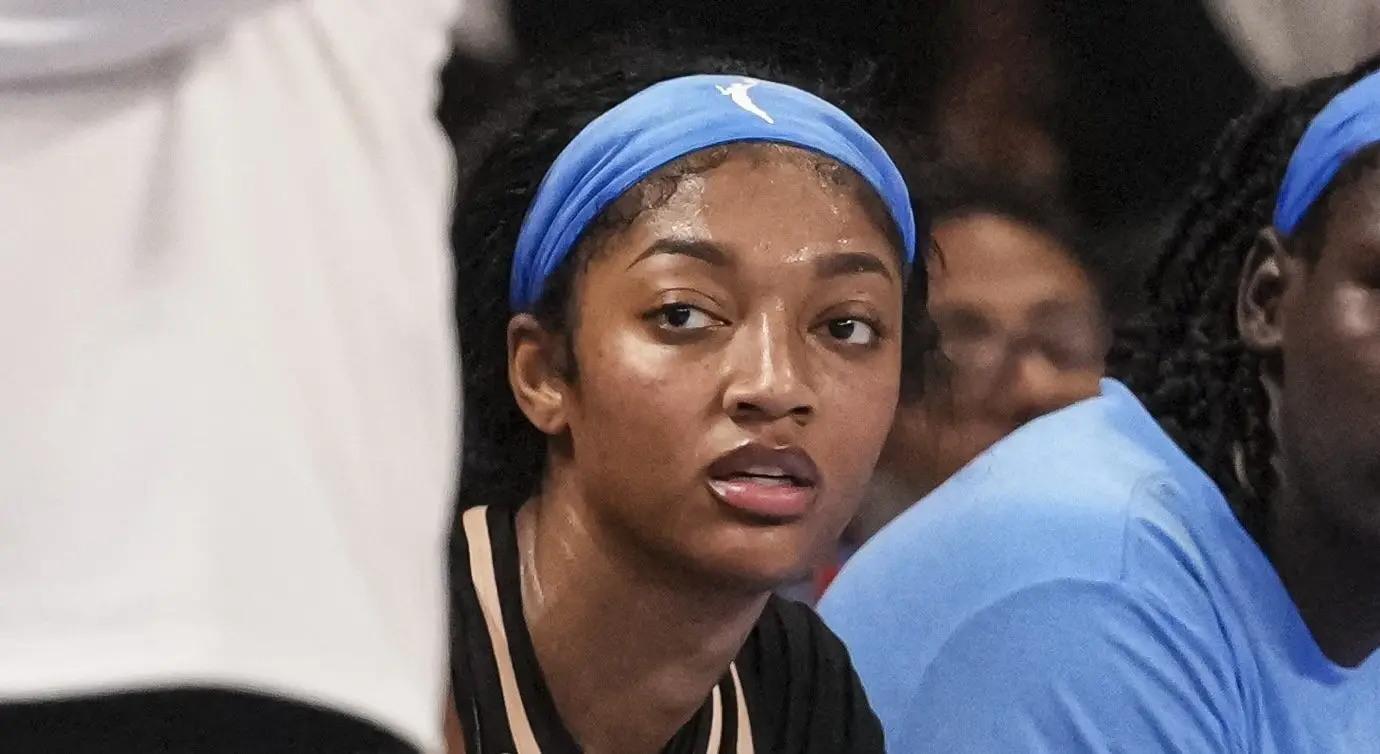
The WNBA season is underway, and the standings are starting to take shape. After making the blockbuster move of the offseason in trading with the Chicago Sky to acquire forward Angel Reese, the Atlanta Dream are at the top of the standings at 4-1.
Reese has brought the grit and determination that defined her during her tenure with the Sky to Atlanta, but she is still struggling with her scoring efficiency, something that could become an issue as competition heats up further into the season and in the playoffs. Her shooting numbers have drawn sharp criticism from fans and analysts alike, particularly her inability to convert on any jump shots so far this season.
Reese is shooting just 40.7% from the field on the year, a brutal stat considering how many of her attempts come at the rim. A detailed breakdown of her shot chart reveals a stark reality: she has made 22 of 47 attempts (46.8%) from within one to five feet, but has missed all seven attempts from beyond that range—including three from five to nine feet, one from 15 to 19 feet, two from 20 to 24 feet, and one from 25 to 29 feet. In total, she is 0-for-7 on jump shots this season, a statistic that has become a focal point for criticism.
One user on social media broke down her shooting percentages even further, and the numbers paint a concerning picture. The tweet by CT Smith highlighted that Reese, despite starting every game this season, has failed to convert on a single jump shot, missing every shot attempt from outside of five feet. This performance has led to widespread backlash on social media platforms, with many questioning her offensive capabilities despite her elite rebounding and defensive presence.
“Imagine not being able to make even half of your layups. But sure, she’s one of the greats because of her rebounding,” one fan wrote on X. Another added, “47% from inside 5 feet happens in 8th grade, not the pros.” A third comment stated, “If she shoots the ball outside of 5 feet it might as well be a turnover.” These remarks underscore the high expectations placed on Reese, who was the No. 7 overall pick in the 2024 WNBA Draft out of LSU and quickly became a fan favorite due to her tenacity and double-double production.
To understand the depth of Reese's shooting woes, it's important to consider her career trajectory. At LSU, she was a dominant force in the paint, averaging 20.9 points and 14.4 rebounds per game during her senior season. However, her mid-range and outside shooting were never considered strengths. In her rookie season with the Chicago Sky, she shot 48.2% from the field, but nearly all of her attempts came at the rim—52% of her shots were layups or dunks, and she attempted just 15 three-pointers all season. Her free throw shooting, a reliable 72.1% in college, fell to 65.3% in the pros, further highlighting her scoring limitations.
After the 2025 season, the Sky traded Reese to the Atlanta Dream in a blockbuster deal that sent several players and draft picks to Chicago. The Dream, a team built around defensive intensity and transition offense, hoped Reese would anchor their frontcourt alongside Cheyenne Parker-Tyus. So far, the gamble is paying off in wins, but the efficiency question looms large. Atlanta is 4-1, tied for the best record in the league, but Reese's offensive struggles could become a liability in close games and playoff matchups where every possession matters.
Defensively, Reese has been exceptional. She is averaging 11.8 rebounds, 1.6 steals, and 1.2 blocks per game, bringing the physicality and hustle that made her a standout in college. Her presence has helped Atlanta become arguably the best defensive team in the league, holding opponents to under 40% shooting. Reese leads the team in defensive rating and is among the league leaders in contested shots. Her ability to impact the game without scoring is undeniable, but modern basketball demands scoring versatility, especially from a starting forward.
Reese spoke to reporters early in the season about how it can be tough on her when she’s struggling to score, but that she knows there are still other ways that she can make an impact on the floor. “I mean, it was obviously rough, rough for me personally, but just being able to fight on both ends of the floor is something that I always know,” Reese said after a poor shooting performance against the Dallas Wings. “If the shot is not falling, I can get it back on defense.” This mindset has endeared her to teammates and coaches, but it does not silence the growing chorus of critics who question whether her ceiling is capped by her inability to score from outside the paint.
Comparisons are inevitable. Players like Breanna Stewart, A’ja Wilson, and Jonquel Jones have revolutionized the frontcourt position with their ability to stretch the floor, shoot from mid-range, and even hit threes. Reese, at 6'3", has the physical tools to develop a reliable jump shot, but her mechanics have often been questioned. She tends to lean back on her release and lacks a consistent follow-through. Despite working with shooting coaches over the summer, the results have not yet translated to game action. Through five games, she has attempted only 12 shots outside the restricted area, making none.
Interestingly, Reese's performance in the paint is also below expectations for a player of her caliber. Shooting 46.8% on shots within five feet is below the league average of around 55% for forwards. That suggests she is not only failing to score from distance but also struggling to finish around the rim against length and athleticism. In college, she relied heavily on her strength to score through contact, but in the WNBA, defenders are taller, stronger, and more disciplined. Her lack of a consistent hook shot or floater makes her predictable, and opponents have begun to sag off her, clogging the lane and daring her to shoot.
Historical context provides some hope. Players like Candace Parker and Elena Delle Donne both went through stretches of shooting inefficiency early in their careers before developing their games to become MVPs. Parker, for instance, shot below 40% from mid-range in her rookie season but later added a reliable three-point shot. However, Parker was already a skilled passer and had a better handle. Reese, by contrast, is primarily a post player who is turnover-prone when forced to dribble. Her assist-to-turnover ratio is 0.5, indicating that she often loses the ball when pressured away from the basket.
Another factor to consider is the Dream's offensive system. Head coach Tanisha Wright has implemented a motion offense that requires all players to be threats from various spots. While the system has yielded great ball movement, with Atlanta averaging 22.4 assists per game, it also exposes Reese's limitations. When she is on the perimeter, defenders ignore her, leading to crowded driving lanes for guards like Rhyne Howard and Allisha Gray. This forces the Dream to run their offense through Reese in the post more often, but her low efficiency there offsets the benefit of her offensive rebounds and second-chance points.
Reese's rebounding, however, remains elite. She leads the team in offensive rebounds (3.2 per game) and is second in the league in total rebound percentage. Her ability to extend possessions is a key reason Atlanta ranks in the top three in second-chance points. She also draws fouls at a high rate, averaging 4.8 free throw attempts per game. But converting those free throws at only 65% again hurts the team's efficiency. If Reese could push her free throw percentage above 80%, it would significantly boost her overall scoring efficiency and make defenders pay for hacking her.
The social media criticism is not entirely fair, as some defenders point out. Reese is only in her second professional season and has already proven she can be a double-double machine. Her intangibles—work ethic, passion, and leadership—are undeniable. She is a key figure in the Dream's culture reset, and her teammates have publicly supported her. Still, the NBA comparison might be apt: players like Ben Simmons or Andre Drummond have faced similar criticism for their inability to shoot, and it ultimately limited their impact in critical moments. The WNBA is increasingly a guard- and wing-dominated league where spacing is paramount, and teams with non-shooting bigs can be schemed out of games.
Looking ahead, the Dream's schedule will test Reese further. Upcoming games against the Las Vegas Aces and New York Liberty will feature elite defenses led by A'ja Wilson and Jonquel Jones, who will likely exploit Reese's shooting weaknesses by playing off her and helping on drives. How Reese responds to these challenges will be telling. She may need to simplify her game, focusing on finishing stronger at the rim, drawing more fouls, and improving her touch on floaters. Additionally, developing a reliable mid-range shot from 10-15 feet would force defenders to respect her, opening up space for her teammates.
Atlanta has established itself as arguably the best defensive team in the league, and Reese has been a major part of that. She’s already averaging a double-double on the season, and if she can fully figure things out on the offensive end, we could see her in the MVP conversation at season’s end. For now, the criticism serves as a barometer of the high expectations placed on her. As one fan tweeted, “She’s a superstar in every way except scoring. If that clicks, watch out.” The next few weeks will reveal whether Reese can evolve her game or whether opponents will continue to exploit her most glaring weakness.
Source: The Comeback: Today’s Top Sports Stories & Reactions News